 Alexey Kuznetsov
- Autonomy. The main feature is that private keys never leave the device and are not exposed to the network.
- Immunity to hacking. Offline wallets are protected from remote hacker attacks and viruses.
- Control. You are the sole owner of your funds, unlike storing them on exchanges.
- Durability. An ideal solution for the HODL strategy and large capital.
Contents:
- The essence of a cold wallet: asset protection principle
- Internal mechanics: how an offline wallet works
- Key advantages: why cold storage is unrivaled
- Main types of cold storage
- Archaic methods: risks of audio and paper solutions
- Hardware wallets: the gold standard of security
- Overview of popular solutions
- Practical guide: setting up a wallet from scratch
- Selection criteria: what to look for when buying
- Maximum security: operating rules
- Direct comparison: cold and hot storage
- Conclusions and choices: current solutions in 2026
- FAQ
What is a cold wallet and how does it protect cryptocurrency
In simple terms, a cold wallet is a way to store cryptocurrency where private keys never touch the internet or vulnerable network attack software. It is often referred to as an offline storage.
Imagine a safe. You don't carry it with you every day to buy coffee, but you keep all your valuables in it: precious items, important documents, large sums of money. A cold wallet is your personal digital safe for Bitcoin, Ethereum, and other assets. Its main task is to create an impenetrable barrier between hackers and the keys to your wealth.
Cold wallet for cryptocurrencies: how it works
It is important to understand the fundamental principle: cold wallets do not store the coins themselves. Cryptocurrency is always in the blockchain - a distributed public database. The wallet only stores private keys that prove your ownership of certain "portions" of this blockchain.
- Private key - a secret combination of letters and numbers that allows you to spend your coins. Whoever owns the key owns the assets.
- Public key - derived from the private key, which can be safely shown to everyone to receive payments.
A cold crypto wallet generates these keys on a special chip of the device, on a computer disconnected from the network, and never "releases" the private key into the online space. When a transaction needs to be made, it is created and signed inside this secure "bubble".
Why a cold wallet is needed and how it is better than hot storage
A cold wallet is needed by anyone who takes the security of their crypto assets seriously. Here are its key advantages over "hot" counterparts:
- Absolute protection against hacker attacks.
- Protection against malware.
- Control over assets.
- Long-term reliability.
Hot wallets (applications, browser extensions) are good for small, everyday amounts, like a wallet in your pocket. But for savings and large investments, cold wallets for cryptocurrencies are the undisputed choice.
Types of cold wallets
All offline storage can be divided into three main categories, differing in convenience, security, and technological sophistication.
Hardware Wallets
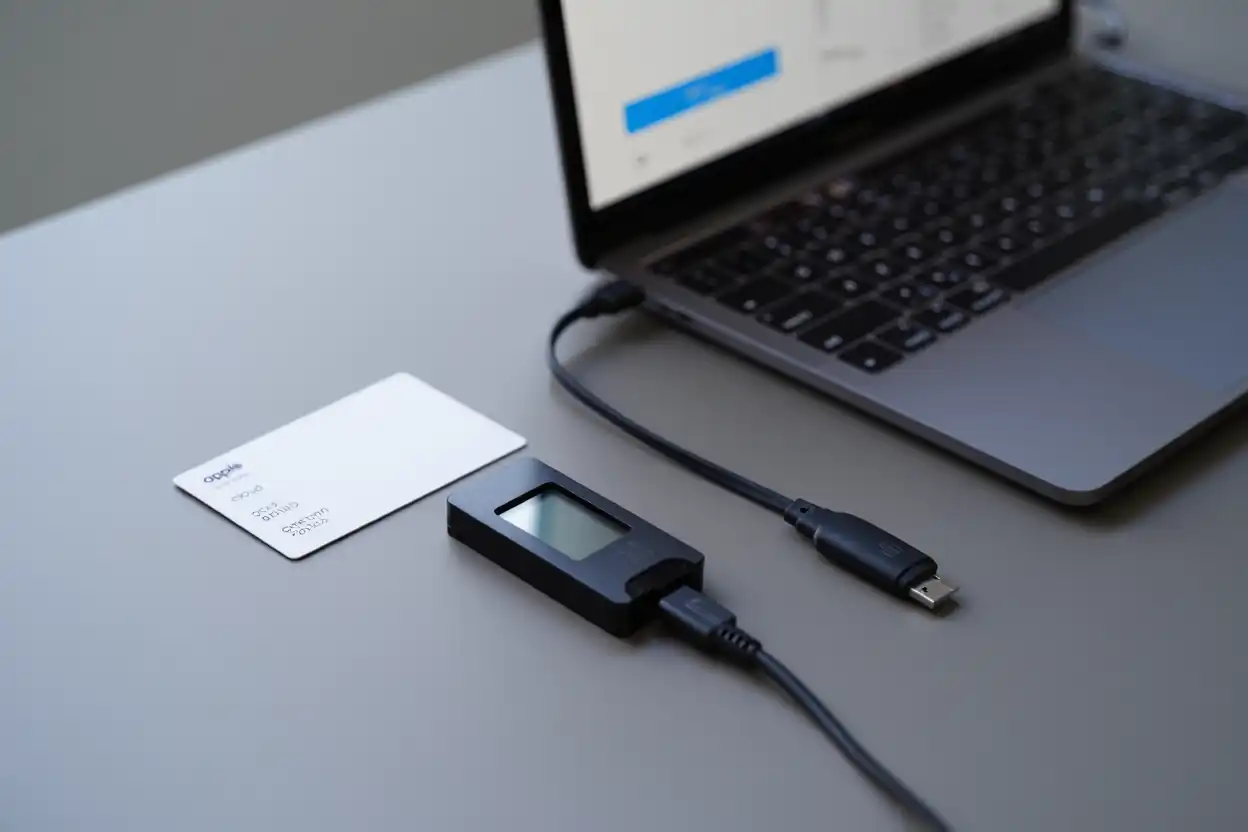
Specialized electronic devices, similar to a USB flash drive with a screen. They are a kind of security standard. Key generation and storage occur on a secure chip inside the device. Examples: Ledger, Trezor.
Paper Wallets
The simplest and cheapest type. Private and public keys are printed on paper as QR codes and text strings. Keys are generated on a computer completely disconnected from the internet.
Software Cold Wallets
These are special programs that are installed on a clean computer that has never been connected to the network. After setting up, the computer is also disconnected from the internet and used only to sign transactions offline. This is secure but less convenient than a hardware solution.
The choice of a specific type depends on your goals. For maximum security and convenience in 2026, hardware solutions are definitely leading. Paper and software wallets remain niche tools for special scenarios.
Paper and Audio Wallets: Outdated but Functional Solutions
Paper wallets were popular in the early days of cryptocurrencies. Their main advantage is simplicity and complete immunity to cyber attacks. However, there are more disadvantages: paper can tear, fade, burn, or get lost. When transferring funds from a paper wallet, it often requires "sweeping" (importing) the private key into a hot wallet, instantly exposing it to risk.
Audio wallets are an exotic method where the private key is encoded into an audio track (for example, in the spectrogram of an audio file) and recorded on a medium. This is an interesting concept but highly impractical and vulnerable to damage to the medium. In 2026, both of these methods are considered archaic and not recommended for newcomers due to the high risk of human error.
Hardware Cold Wallets: Reliable Cryptocurrency Storage
This is the most recommended type of cold wallet for cryptocurrencies. The device is a compact gadget with buttons and a screen, often with a secure element (Secure Element) like in bank cards or passports.
How it works:
- You connect the wallet to a computer or phone;
- The companion application shows the address to receive funds and creates transaction drafts;
- The transaction itself is signed inside the device;
- The signed transaction is sent to the connected device and then to the network.
Even if your computer is infected, a virus cannot steal the keys or change the recipient's address.
Ledger Cold Wallet: Features and Advantages
Speaking of hardware wallets, one of the most well-known brands cannot be overlooked - Ledger. Such cold wallets have gained popularity due to a number of features:
- Secure Element (SE). Use of a secure chip certified to government security standards, providing the highest level of key protection.
- Custom Software. Convenient application for managing the portfolio, staking, and even buying assets through partners like Nadoswap.
- Support for a huge number of assets. Over 5500 coins and tokens.
- Intuitive interface. Management is done through a small screen and two physical buttons.
It is important to remember that when buying a cold wallet, you